6 Minute read
What is Phase Change Material?
Phase change materials (PCM) are substances that absorb and release thermal energy during the process of melting and freezing. When a PCM freezes, it releases a large amount of energy in the form of latent heat at a relatively constant temperature. Conversely, when Phase Change Material melts, it absorbs a large amount of heat and slows the heating of your products being shipped or stored. PCMs recharge when the external temperature drops above or below their crystallization points, this self charging process separates them from traditional ice based solutions for example and makes them perfect for temperature control logistics.
TLX Cargo was the first company in the world to incorporate PCM into a thermal blanket. This unique technology has opened up a new and exciting range of product for temperature controlled logistics.
We use PCM instead of as ice has no flexibility with water’s freezing point being fixed at 0°C (32°F), this temperature just isn`t achievable in nearly all transport situations.
On the flip side of this, PCMs can be use across a broad range of temperatures, from -40°C to more than 150°C. They typically store 5 to 14 times more heat per unit volume than materials such as water, masonry or rock. PCMs have the added benefit of offer high-density energy storage and store heat within a narrow temperature range of just a few degrees celsius.
Types of PCM Material?
Phase Change Material fall into four main categories, which are listed below:
TLX Cargo use Biobased PCMs in our TLX PCM cargo cover range including TLX Fibre-Flex PCM blankets for air and Ocean Freight shipment. This PCM is made from organic compounds derived from plant foods mainly and animal fats. Their melting zone range between -40°C and 151°C giving us a large amount of flexibility. The most common biobased PCMs are derived from fatty acids and have higher efficiency than salt hydrates and petroleum-based phase change material. The other advantages of biobased phase change material:
- They are nontoxic.
- They can last for decades.
- They have very high latent heat.
- They experience minimal volume change between phases.
- They are stable PCM always giving consistent results.
- Perfect product for a PCM thermal blanket
Salt hydrates PCM consist of inorganic salts and water. Their melt point temperatures range between 15°C and 80°C so less range than organic PCM. The advantages of salt hydrates are low material costs, high latent heat storage capacity, precise melting point, high thermal conductivity and non flammable.
The disadvantages:
- Vulnerable to supercooling, the phenomenon in which a substance cools below its freezing point without solidifying. This becomes a major problem when shipping in the 2-8 range.
- It changes volumes by up to 10%. Special packaging must be used to accommodate the changing volume, which can`t be used for specialist application like TLX Fibre-Flex and TLX PCM cargo covers.
- Some salt hydrates don`t always completely recrystallize on each cycle. If this continues they lose their latent heat capacity (stop working).
- Some salt hydrates are toxic and many are corrosive to metals, presenting safety and disposal issues.
Paraffin PCM, Derived from petroleum and have a waxy feel at room temperature. Their melt point temperatures range between -8°C and 40°C so the most limited from the true PCM materials available. They have good thermal storage capacity and are proven to freeze without supercooling. They tend to be very stable over a large number of cycles giving a good consistent result for the client.
They don`t tend be corrosive like salt based products and are compatible with most encapsulation materials. The prices are volatile and can be led by petroleum fluctuations (environmental impact should not be ignored). The environmental impact of petroleum should not be ignored. Many paraffins are hazardous to health and the environment. Some can injure skin, eyes and mucous membranes.
Water-based ice and gel packs are extremely popular firstly because of price (very cheap) and they maintain 0°C effectively. They are also nontoxic, non-flammable, environmentally friendly and easy to use. The disadvantages: They are useful only in applications requiring a temperature of 0°C.
TLX Cargo Encapsulates PCM inside a thermal blanket
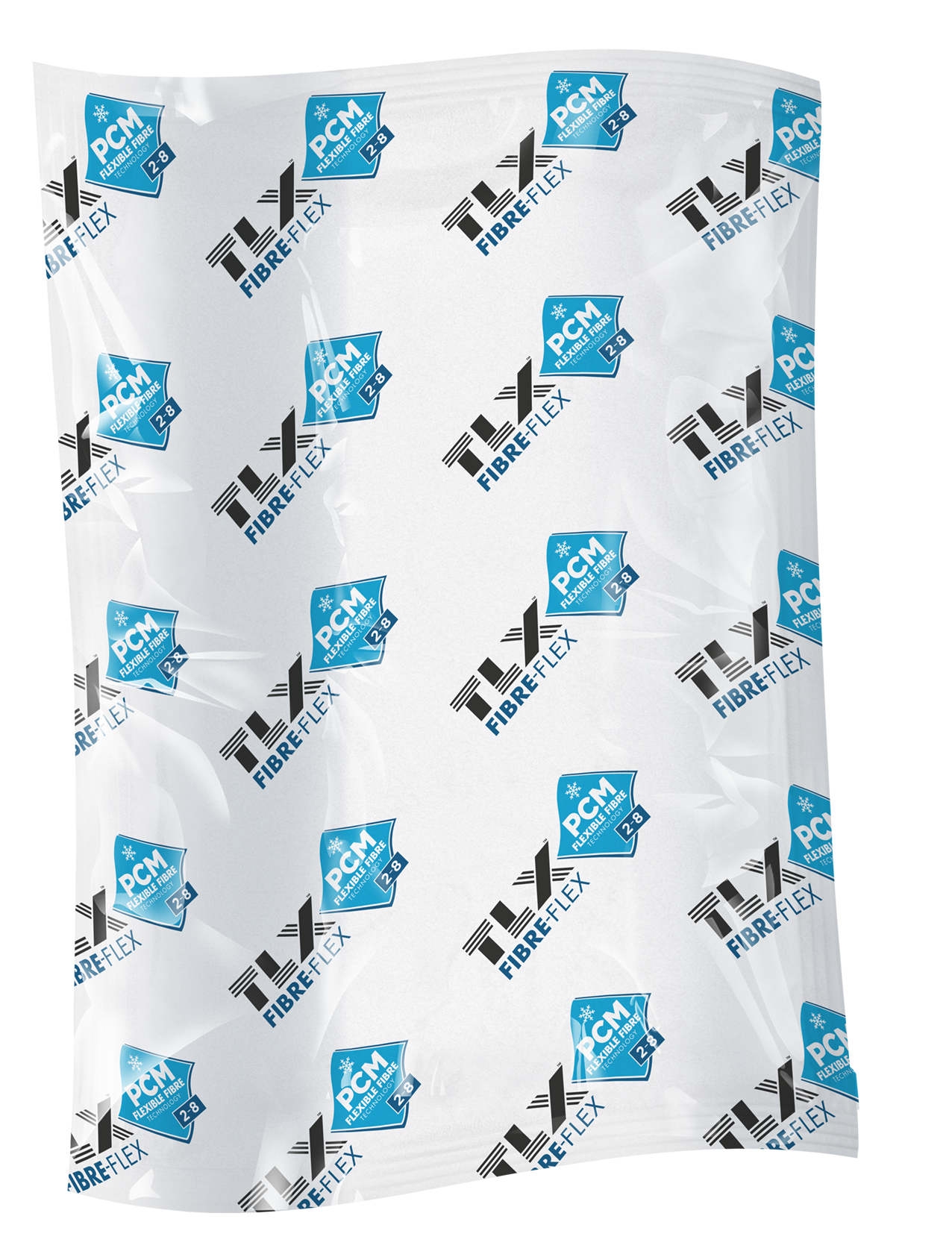 PCMs are generally available in three forms: unencapsulated raw PCM, micro encapsulated PCM and micro encapsulated PCM. The difference between the two encapsulated options is the size of the particle. Inorganic and water-based PCMs cannot be encapsulated.
Encapsulation of a PCM adds an outer shell to the PCM core to prevent leakage, degradation and contamination. In the development of our TLX PCM thermal blanket range we developed a unique way of encapsulating PCM in very thin sheets of fibre often just millimetres thick, these sheets are flexible and only take 1hr to condition, making them perfect for air cargo covers or ocean freight solutions.
The image is of a 1mm thick sheet of PCM which TLX Cargo can produce to fit any pallet dimension required
TLX Cargo developed this technology into products used for temperature controlled logistics, breaking new ground.
Below is an image of a 2mm thick thermal blanket TLX Fibre-Flex PCM, that incorporates PCM within it`s entire structure, on all 5 sides. This very thin flexible layer of PCM covering the entire pallet gives unrivalled protection as a thermal blanket against both high and low excursions, when compared with traditional solutions. Perfect for both air and ocean freight protection.
Why TLX Cargo uses Biobased PCM’s

What determines the quality of PCM?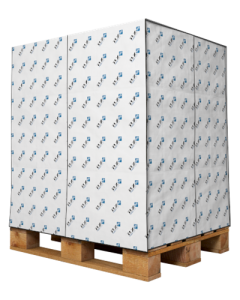
Sharpness of latent heat release points – Put simply, this means the release and absorption of latent heat over a narrow temperature range, which is very important for thermal blankets, why? Well the margins are so small with a thermal blanket vs a box or pallet shipper, our covers are only millimetres thick and provide shock temperature protections.
Temperature – Label claims come with specific temperature ranges 2-8 or 15-25 for example is common in Pharma. The Pharma companies require their products to be held within 1-2 degrees of a set point. TLX PCM cargo covers stop the risk of a sharp temperature spike ruining a products integrity.
Stability to cycling and aging – Over the course of thousands of freezes and melt cycles, the phase change transition temperature and latent heat energies should remain consistent. Changes in the hydration sphere of some PCM molecules over time can affect the melt and freeze points and their respective latent heats. When this happens you lose performance without even knowing it until it`s too late! That`s why TLX used Biobased PCM as it`s ability to perform over 7000+ cycles is proven.
Latent heat – Latent heat is measured in joules per gram. Preferred latent heats are greater than 150 J/g and preferably greater than 180 J/g.
Non-corrosive to encapsulation – Encapsulation of the PCMs involves a PCM core and an outer shell to prevent leakage, degradation and contamination. Choosing the correct plastic or metal to encapsulate or hold your PCM is critical, if you get this wrong you will get a leak. Plastic tends to be the most common container for PCM chemicals either in briquettes or gel packs. However, containers with thick plastic walls suffer from low thermal conductivity, metals tend to be more costly and can corrode with some PCMs.
Cost effective – If you can start to reuse the systems that use PCM like TLX Fibre-Flex PCM thermal blankets, it has a huge impact on your costs, we work with global partners on a rental and reuse program to support our customers.
Safe to use – The PCM should be nontoxic, non-flammable and environmentally friendly, which is why we choose a biobased product.
End of life cycle – At the end of the life of a PCM application the PCM should be able to be land-filled and degrade naturally within 6-12 months, only a biobased PCM can do this.
What is Latent heat capacity?
There are two kinds of heat energy: sensible and latent. Most common heat storage systems, such as a conventional water heater, use sensible heat, the energy needed to alter the temperature of a substance with no phase change. Latent heat, which can be 100 times that of sensible heat, is the amount of energy required to change matter from one state to another, liquid to solid or vice versa. Sensible heat and latent heat work together in thermal storage materials like. This results in the ability to maintain specific temperatures for extended periods of time.
Examples of latent heat capacity
Ice cubes, using their latent heat capacity, absorb large amounts of heat energy from a drink. When all the ice has melted, the cubes have essentially absorbed all their latent energy capacity and then the drink warms to room temperature. Conversely, when hot wax is dripped on skin, a burning sensation is caused by the wax releasing all its internal latent heat energy.